

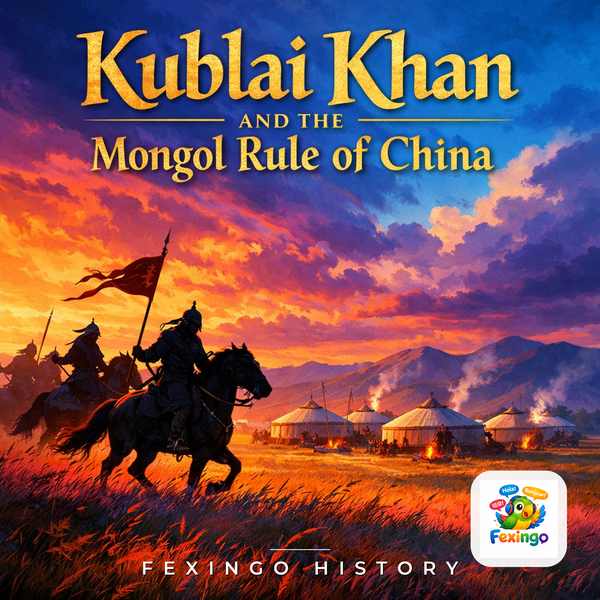
Kublai Khan and the Mongol Rule of China — Fexingo History
FexingoKublai Khan, grandson of Genghis, completed what his grandfather began: the conquest of China. By 1279, his Mongol armies had extinguished the Song Dynasty, establishing the Yuan Dynasty that would rule China for nearly a century. But Kublai was more than a conqueror—he was a builder of cities, a patron of the arts, and a ruler who blended Mongol steppe traditions with Chinese Confucian governance... more
| Publishes | Daily | Episodes | 124 | Founded | 2 months ago |
|---|---|---|---|---|---|
| Number of Listeners | Categories | HistorySociety & Culture | |||
Listen to this Podcast


Latest Episodes
In this episode of Fexingo History, Lucas and Luna explore the Mongol Yam — the empire-spanning postal relay system that Kublai Khan inherited and expanded across Yuan China. They trace its origins under Genghis Khan, its rapid horse stations and pai... more
In this episode, Lucas and Luna explore Kublai Khan's lesser-known passion for polo, or 'jiju' in Chinese. They discuss how the Mongol ruler imported the game from Persia, built dedicated polo fields in Dadu (modern Beijing), and even organized grand... more
Kublai Khan's reign over China is often told through his military campaigns or his administrative innovations. But what about the Chinese scholar-officials who refused to serve the Mongol court? This episode of Fexingo History examines the phenomenon... more
In this episode, we explore Kublai Khan's conversion to Tibetan Buddhism and his appointment of the Sakya lama Drogön Chögyal Phagpa as Imperial Preceptor. Phagpa created the 'Phagspa script' for writing Mongolian, Chinese, and other languages, and h... more
Before the modern era, Kublai Khan's Yuan Dynasty attempted a radical economic experiment: replacing metal coinage with paper money as the sole legal tender. In this episode, Lucas and Luna explore the origins of Mongol paper currency, from the Chine... more
When Kublai Khan conquered China, he brought the Mongol steppe with him—literally. In this episode, Lucas and Luna explore the vast imperial hunting parks that Kublai built around his new capital of Dadu (modern Beijing). These weren't just pleasure ... more
In this episode, Lucas and Luna explore the remarkable achievements of Guo Shoujing, the Yuan dynasty astronomer and engineer who built the Great Water Clock for Kublai Khan's new capital at Dadu. They discuss how Guo Shoujing designed the Lingtai as... more
In this episode, Lucas and Luna explore Kublai Khan's most enduring infrastructure project: the rebuilding and extension of China's Grand Canal. While earlier episodes have covered Kublai's military campaigns, financial reforms, and administrative in... more
Key Facts




Hosts
Chart Rankings
How this podcast ranks in the Apple Podcasts, Spotify and YouTube charts.
Apple Podcasts | #228 |  Germany/History Germany/History |

Top History Podcasts


Audience Metrics
Listeners, social reach, demographics and more for this podcast.
| Listeners per Episode | Gender Skew | Location | |||
|---|---|---|---|---|---|
| Interests | Professions | Age Range | |||
| Household Income | Social Media Reach | ||||
Frequently Asked Questions About Kublai Khan and the Mongol Rule of China
What is Kublai Khan and the Mongol Rule of China about and what kind of topics does it cover?
Two hosts explore the rise and reign of a legendary ruler who forged a cross-continental empire by blending nomadic traditions with Confucian governance. Episodes center on conquest, state-building innovations (notably paper currency, a unified postal system, and a census), and the paradoxes of legitimacy that come with ruling a vast, multi-ethnic realm. The series also covers dramatic episodes such as failed invasions, environmental shocks, and the suppression of dissent, using these events to illuminate how imperial power balanced coercion with cultural co-optation. Noteworthy angles include debates over whether the ruler was a Chinese-style emperor or an “alien” Mongol overlord, and how economic policy, religious patronage, and monumenta... more
Where can I find podcast stats for Kublai Khan and the Mongol Rule of China?
Rephonic provides a wide range of podcast stats for Kublai Khan and the Mongol Rule of China. We scanned the web and collated all of the information that we could find in our comprehensive podcast database. See how many people listen to Kublai Khan and the Mongol Rule of China and access YouTube viewership numbers, download stats, audience demographics, chart rankings, ratings, reviews and more.
How many listeners does Kublai Khan and the Mongol Rule of China get?
Rephonic provides a full set of podcast information for three million podcasts, including the number of listeners. View further listenership figures for Kublai Khan and the Mongol Rule of China, including podcast download numbers and subscriber numbers, so you can make better decisions about which podcasts to sponsor or be a guest on. You will need to upgrade your account to access this premium data.
What are the audience demographics for Kublai Khan and the Mongol Rule of China?
Rephonic provides comprehensive predictive audience data for Kublai Khan and the Mongol Rule of China, including gender skew, age, country, political leaning, income, professions, education level, and interests. You can access these listener demographics by upgrading your account.
How many subscribers and views does Kublai Khan and the Mongol Rule of China have?
To see how many followers or subscribers Kublai Khan and the Mongol Rule of China has on Spotify and other platforms such as Castbox and Podcast Addict, simply upgrade your account. You'll also find viewership figures for their YouTube channel if they have one.
How many episodes of Kublai Khan and the Mongol Rule of China are there?
Kublai Khan and the Mongol Rule of China launched 2 months ago and published 124 episodes to date. You can find more information about this podcast including rankings, audience demographics and engagement in our podcast database.
How do I contact Kublai Khan and the Mongol Rule of China?
Our systems regularly scour the web to find email addresses and social media links for this podcast. We scanned the web and collated all of the contact information that we could find in our podcast database. But in the unlikely event that you can't find what you're looking for, our concierge service lets you request our research team to source better contacts for you.
Where can I see ratings and reviews for Kublai Khan and the Mongol Rule of China?
Rephonic pulls ratings and reviews for Kublai Khan and the Mongol Rule of China from multiple sources, including Spotify, Apple Podcasts, Castbox, and Podcast Addict.
View all the reviews in one place instead of visiting each platform individually and use this information to decide if a show is worth pitching or not.
How do I access podcast episode transcripts for Kublai Khan and the Mongol Rule of China?
Rephonic provides full transcripts for episodes of Kublai Khan and the Mongol Rule of China. Search within each transcript for your keywords, whether they be topics, brands or people, and figure out if it's worth pitching as a guest or sponsor. You can even set-up alerts to get notified when your keywords are mentioned.