

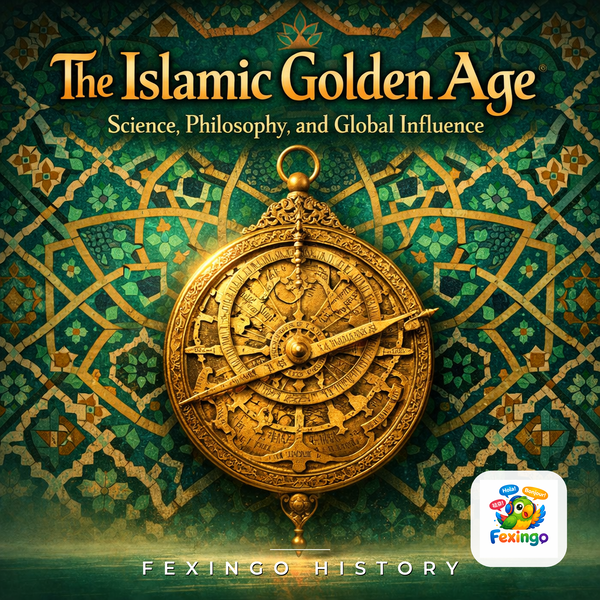
The Islamic Golden Age: Science, Philosophy, and Global Influence — Fexingo History
FexingoFrom the 8th to the 13th centuries, the Abbasid Caliphate fostered an unprecedented flourishing of science, philosophy, and culture. In Baghdad's House of Wisdom, scholars like al-Khwarizmi pioneered algebra, while al-Razi advanced medicine and Ibn Sina (Avicenna) synthesized Aristotelian thought with Islamic theology. This era saw the translation and preservation of Greek classics, the developmen... more
| Publishes | Daily | Episodes | 151 | Founded | 3 months ago |
|---|---|---|---|---|---|
| Number of Listeners | Categories | Society & CultureHistory | |||
Listen to this Podcast


Latest Episodes
This episode dives into the origins and evolution of the madrasa, the medieval Islamic college that became the backbone of higher education across the Muslim world. We trace its development from the early study circles in mosques to the formalized in... more
Before the printing press, paper was a luxury—and then it became an industry. In this episode, Lucas and Luna explore how the Abbasid caliphate transformed paper from a Chinese secret into a mass-produced engine of learning. Samarkand's 751 CE battle... more
Before Ibn Sina's Canon, there was al-Razi — a Persian physician, alchemist, and skeptic who questioned everything, from Galen's authority to the existence of prophets. In this episode, Lucas and Luna explore the life and legacy of Abu Bakr Muhammad ... more
When we think of the Islamic Golden Age, we picture the House of Wisdom, astrolabes, and sprawling cities like Baghdad and Cordoba. But behind those great institutions lay an often-overlooked engine: the waqf, or charitable endowment. In this episode... more
In this episode, Lucas and Luna explore the secret intelligence network of the Fatimid Caliphate, focusing on the da'wa—the Ismaili missionary system that doubled as a spy ring. They discuss the role of al-Qadi al-Nu'man in codifying Ismaili law and ... more
Abu Hamid al-Ghazali, one of the most influential thinkers in Islamic history, began as a celebrated philosopher before turning against the very tradition he once championed. This episode explores his life, from his early career at the Nizamiyya madr... more
This episode of Fexingo History explores the qanat, the ancient underground irrigation system that sustained cities and farms across the Islamic world for over two millennia. Lucas and Luna trace the technology from its Achaemenid origins through its... more
This episode explores the life and work of Muhammad al-Idrisi, a 12th-century Muslim geographer who created the Tabula Rogeriana, one of the most accurate world maps of the pre-modern era. Commissioned by the Norman king Roger II of Sicily, al-Idrisi... more
Key Facts




Hosts
Chart Rankings
How this podcast ranks in the Apple Podcasts, Spotify and YouTube charts.
Apple Podcasts | #156 |  India/History India/History |

Top History Podcasts


Talking Points
Recent interactions between the hosts and their guests.
Audience Metrics
Listeners, social reach, demographics and more for this podcast.
| Listeners per Episode | |
|---|---|
| Gender Skew | |
| Location | |
| Interests | |
| Professions | |
| Age Range | |
| Household Income | |
| Social Media Reach |
Frequently Asked Questions About This Podcast
What is This Podcast about and what kind of topics does it cover?
A historically rich program exploring the Islamic Golden Age, with a focus on how Baghdad's House of Wisdom and a network of scholars shaped algebra, medicine, astronomy, philosophy, and geography. Episodes trace the translation movement, cross-cultural exchanges, and the innovations that influenced later European science and thought, from algebra and numerals to optics and maps. Listeners can expect deep dives into pivotal figures like al-Khwarizmi, Ibn Sina, and al-Razi, along with broader stories about the era's institutions, debates between reason and faith, and the era's lasting legacy beyond its borders. A notable strength is the emphasis on cross-cultural collaboration and practical innovations that helped seed later Renaissance thin... more
Where can I find podcast stats for this podcast?
Rephonic provides a wide range of podcast stats for this podcast. We scanned the web and collated all of the information that we could find in our comprehensive podcast database. See how many people listen to this podcast and access YouTube viewership numbers, download stats, audience demographics, chart rankings, ratings, reviews and more.
How many listeners does this podcast get?
Rephonic provides a full set of podcast information for three million podcasts, including the number of listeners. View further listenership figures for this podcast, including podcast download numbers and subscriber numbers, so you can make better decisions about which podcasts to sponsor or be a guest on. You will need to upgrade your account to access this premium data.
What are the audience demographics for this podcast?
Rephonic provides comprehensive predictive audience data for this podcast, including gender skew, age, country, political leaning, income, professions, education level, and interests. You can access these listener demographics by upgrading your account.
How many subscribers and views does this podcast have?
To see how many followers or subscribers this podcast has on Spotify and other platforms such as Castbox and Podcast Addict, simply upgrade your account. You'll also find viewership figures for their YouTube channel if they have one.
How many episodes of this podcast are there?
this podcast launched 3 months ago and published 151 episodes to date. You can find more information about this podcast including rankings, audience demographics and engagement in our podcast database.
How do I contact this podcast?
Our systems regularly scour the web to find email addresses and social media links for this podcast. We scanned the web and collated all of the contact information that we could find in our podcast database. But in the unlikely event that you can't find what you're looking for, our concierge service lets you request our research team to source better contacts for you.
Where can I see ratings and reviews for this podcast?
Rephonic pulls ratings and reviews for this podcast from multiple sources, including Spotify, Apple Podcasts, Castbox, and Podcast Addict.
View all the reviews in one place instead of visiting each platform individually and use this information to decide if a show is worth pitching or not.
How do I access podcast episode transcripts for this podcast?
Rephonic provides full transcripts for episodes of this podcast. Search within each transcript for your keywords, whether they be topics, brands or people, and figure out if it's worth pitching as a guest or sponsor. You can even set-up alerts to get notified when your keywords are mentioned.