

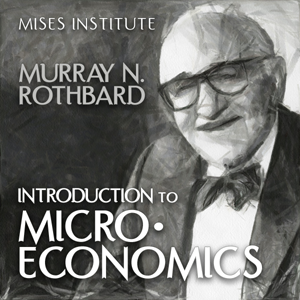
Introduction to Microeconomics
Murray N. RothbardPresented by Murray N. Rothbard in 1986 at New York Polytechnic University. Recorded by Hans-Hermann Hoppe. Download the complete audio of this event (ZIP) here.
| Publishes | Daily | Episodes | 14 | Founded | 16 years ago |
|---|---|---|---|---|---|
| Category | Podcasts | ||||
Listen to this Podcast


Latest Episodes
The time market determines the pure rate of interest. Price per unit of time may be wages or rent. The interest income will be earned by the capitalist who has assumed the task of advancing present money. The capitalist then waits for five years unti... more
In order for anyone to make ethical judgments, he must know the consequences of his various actions. In questions of union actions displacement or unemployment for oneself or others will be considered unfortunate by most people. Once understood, far ... more
Economists can say little about population and its size, despite the gloomy views of Malthus. More people are a good thing because of the division of labor. Living standards are higher when populations are higher. Living standards are higher when pop... more
As factors of production, supply and demand of labor, land and capital will determine how much the producer will get out of this process. This process occurs in different stages. In the earlier or higher stages, producers' goods must be produced that... more
The only cartels that have lasted have been government cartels. There is no essential difference between a cartel and an ordinary corporation or partnership. Not even the De Beers cartel is all powerful. The South African government nationalizes all ... more
Business men must make sure they can cover their costs by incoming revenue. The production function will yield a certain quantity of a product. The firm considers marginal costs and average costs to weigh where along the demand curve production is. ... more
Thou shalt not sell a certain product or service below a certain price, e.g. wheat, cotton, corn, cheese, sugar. This will result in an artificial unsold permanent surplus, as it does in the American farm situation. Initially resources are attracted ... more
The words monopoly and competition have been changed. Competition meant rivalry or competing, either active or potential. Businesses do not like this. Monopoly meant a grant of privilege by the government. It now means a falling demand curve. Govern... more
Key Facts


Reviews
- Essential
Dr. Rothbard's introduction to macroeconomics should be standard, required reading for idle and high school students. His style is often humorous, witty and cutting. Three things missing from the vast majority of economic literature. "The dismal science" as Rothbard put it, would be far less dismal if he wrote more of the material required in Econ courses!
Apple Podcasts5Darth Kazi United States14 years ago
 - Fantastic
No one does it like Murray. Entertaining and informative.
Apple Podcasts5Jeffrey CilleyUnited States14 years ago - Rothbard is brilliant!
An amazingly detailed overview of micro-economics! Real world examples, and historical exegesis a-plenty! Buckaloaf!
Apple Podcasts5Scott TrinhUnited States16 years ago

Audience Metrics
Listeners, social reach, demographics and more for this podcast.
| Gender Skew | Location | Interests | |||
|---|---|---|---|---|---|
| Professions | Age Range | Household Income | |||
| Social Media Reach | |||||
Frequently Asked Questions About Introduction to Microeconomics
Where can I find podcast stats for Introduction to Microeconomics?
Rephonic provides a wide range of podcast stats for Introduction to Microeconomics. We scanned the web and collated all of the information that we could find in our comprehensive podcast database. See how many people listen to Introduction to Microeconomics and access YouTube viewership numbers, download stats, audience demographics, chart rankings, ratings, reviews and more.
How many listeners does Introduction to Microeconomics get?
Rephonic provides a full set of podcast information for four million podcasts, including the number of listeners. View further listenership figures for Introduction to Microeconomics, including podcast download numbers and subscriber numbers, so you can make better decisions about which podcasts to sponsor or be a guest on. You will need to upgrade your account to access this premium data.
What are the audience demographics for Introduction to Microeconomics?
Rephonic provides comprehensive predictive audience data for Introduction to Microeconomics, including gender skew, age, country, political leaning, income, professions, education level, and interests. You can access these listener demographics by upgrading your account.
How many subscribers and views does Introduction to Microeconomics have?
To see how many followers or subscribers Introduction to Microeconomics has on Spotify and other platforms such as Castbox and Podcast Addict, simply upgrade your account. You'll also find viewership figures for their YouTube channel if they have one.
How many episodes of Introduction to Microeconomics are there?
Introduction to Microeconomics launched 16 years ago and published 14 episodes to date. You can find more information about this podcast including rankings, audience demographics and engagement in our podcast database.
How do I contact Introduction to Microeconomics?
Our systems regularly scour the web to find email addresses and social media links for this podcast. We scanned the web and collated all of the contact information that we could find in our podcast database. But in the unlikely event that you can't find what you're looking for, our concierge service lets you request our research team to source better contacts for you.
Where can I see ratings and reviews for Introduction to Microeconomics?
Rephonic pulls ratings and reviews for Introduction to Microeconomics from multiple sources, including Spotify, Apple Podcasts, Castbox, and Podcast Addict.
View all the reviews in one place instead of visiting each platform individually and use this information to decide if a show is worth pitching or not.
How do I access podcast episode transcripts for Introduction to Microeconomics?
Rephonic provides full transcripts for episodes of Introduction to Microeconomics. Search within each transcript for your keywords, whether they be topics, brands or people, and figure out if it's worth pitching as a guest or sponsor. You can even set-up alerts to get notified when your keywords are mentioned.