
Want to get featured as a guest on podcasts but not sure how to pitch yourself effectively? Pitching yourself as a podcast guest requires research, personalization, and clear communication of the unique value you bring.
There are hundreds of thousands of active podcasts out there, and plenty of them are actively looking for guests. Hosts receive a lot of pitches, so you need a guest pitch that resonates with them and their audience.
Mastering how to pitch yourself as a podcast guest can open doors to new audiences, build your credibility, and grow your network organically. This guide will help you do exactly that.
Jump straight to the guest pitch template here.Table of Contents
The benefits of podcast guesting
Landing podcast appearances bring benefits that go far beyond a single interview. As a guest, you reach a focused audience already interested in your expertise, which boosts your visibility and builds your credibility.
They also help you form meaningful connections with influential hosts and fellow guests. When handled well, these relationships can expand your professional network.
Every episode you join becomes a credibility asset you can share on social media, your website, and with your email list. That makes podcast appearances especially useful for growing a business organically. Founders, authors, and podcasters all find them to be a powerful growth tool.
Don’t do this!
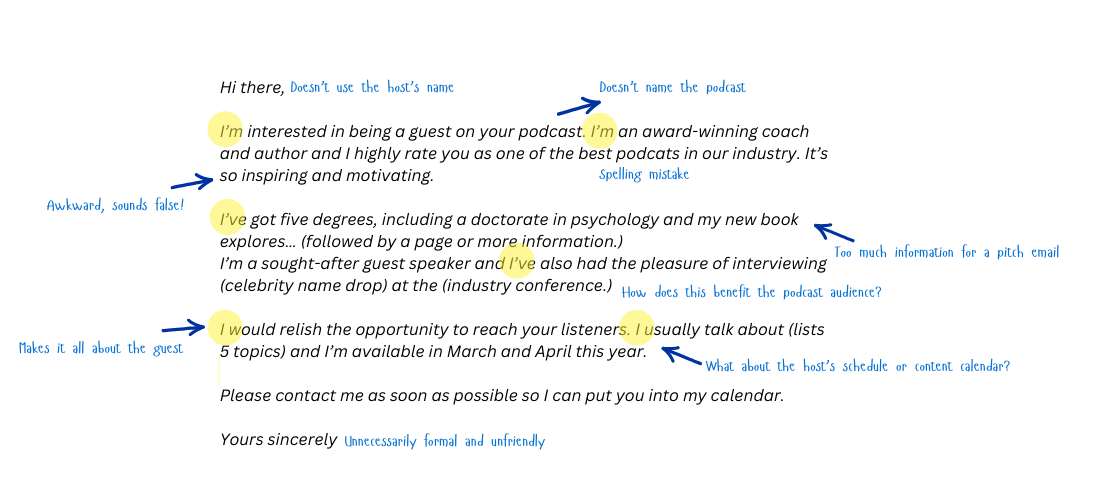
First up, let’s look at a ‘bad’ pitch—a composite of howlers we’ve seen and heard about. This one’s full of common mistakes that you REALLY don’t want showing up in your emails.
Podcast hosts have a few vital questions top of mind when they’re considering a potential guest:
- What’s this person like?
- Are they a good fit for the show, or could they be the wrong fit?
- Do they add value for our listeners?
- Can they have an engaging conversation?
- Will we get along well?
- How easy will it be to work with them?
Does the above pitch answer any podcast host questions? No, it doesn’t. The pitch fails to show why John Doe would be a good potential guest and risks being seen as the wrong fit. Even if they bothered to open it, that email’s headed for the trash.
Example pitch to use as a guest
We drafted this podcast guest pitch using the ChatGPT tool we created—you can try it here. We only needed to make a few small tweaks, and it was ready to send!
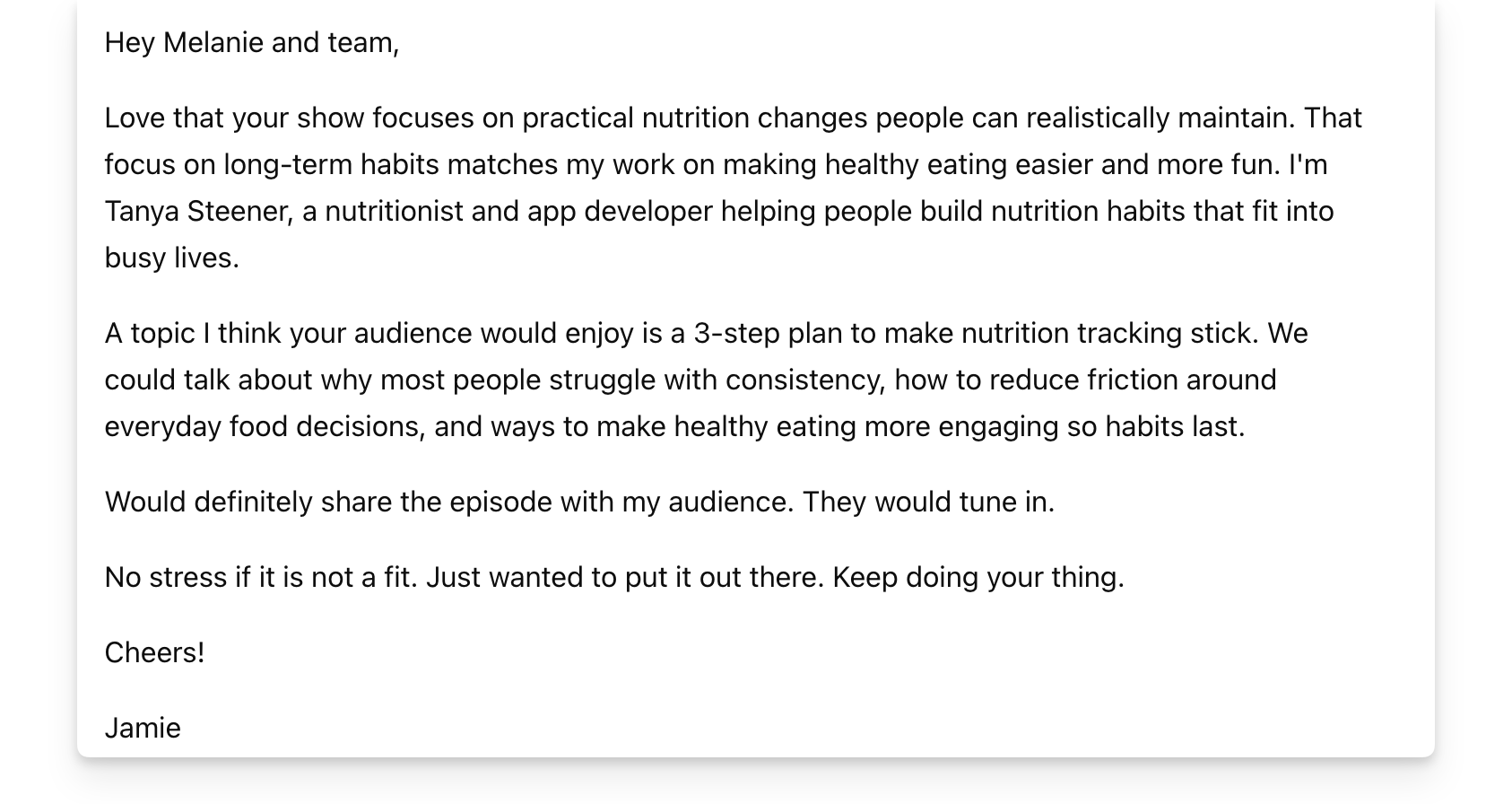
This pitch opens by naming the host and showing the sender has actually listened to several episodes — a must before pitching.
It quickly ties the podcast’s focus to the guest’s expertise, then gives a brief, on-point bio suited to the audience.
It suggests specific, useful topics that address the audience’s needs and makes clear the guest intends to add real value. It also offers to help promote the episode while keeping things low-pressure for the host.
8 tips to pitch yourself as a podcast guest
If you'd rather learn how to write a podcast guest pitch from scratch than follow a template, this guide will walk you through the process.

First off, do yourself and them a favor, and keep your pitch brief—200 words max. (Keep that in mind as we go through these tips.). As you review these tips, remember that your pitch should be personalized, value-driven, and focused on how you can benefit the podcast’s audience.
A good pitch clearly demonstrates the value you bring, not just your own achievements. Podcast hosts prioritize pitches that focus on audience value and actionable takeaways, rather than simply highlighting personal accomplishments.
#1. Introduce yourself as a podcast guest
The host probably won’t recognize your name, so let them know who you are and what you do by offering credibility.
Be friendly, genuine, and establish credibility by including a concise professional bio—you could even link to past media appearances. You might include a sentence or two about your expertise, such as being a SaaS founder or running a bootstrapped SaaS business, or the project you’re working on, but only if it’s relevant.
Mentioning that you’ve been featured in a major publication or on a major publication website can add more credibility. Imagine you’re a business coach focused on entrepreneur well-being. You could introduce yourself like this:
#2. Pitch unique talking points

How will you add value to the podcast? That’s likely the host’s number one consideration.
They probably won’t be interested in a topic they’ve already covered, so don’t go there unless you’re offering fresh ideas or a revolutionary solution. Instead, propose a topic or angle that hasn't been heavily covered on the show.
For example, you might suggest discussing scaling business challenges, sharing SaaS business growth tactics, or exploring organic marketing tactics. What specific problems does their audience have that you can help solve? Make sure your proposed topics are relevant and not overdone, so you avoid being the wrong fit for the show.
#3. Reference previous content
Show you’ve done your homework and genuinely listened to the podcast by taking the time to listen to a few episodes before pitching.
You might:
- Mention a moment that stood out to you in a previous episode
- Offer your perspective on the guest’s remarks
- Refer to a comment a listener left on YouTube or Apple
Be authentic, and really do your homework. Listen to recent episodes and, after you’ve finished listening, mention a specific takeaway to prove your genuine interest.
If you send an email saying I’m a big fan of the show, or I loved a particular episode, you’d better believe they’ll want to know which episode and why you liked it. To personalize your pitch effectively, mention specific episodes of the podcast that you enjoyed and explain why they resonated with you, demonstrating that you are familiar with the host's content.
I just finished listening to your episode with Joe Bloggs – loved how you tackled the tough balance between work and mental health! As someone who’s seen firsthand how important this is for entrepreneurs, I’m eager to build on this conversation with you.
Referencing a few episodes and sharing specific takeaways shows you’ve truly engaged with the podcast and helps your pitch stand out.
#4. Attach a one-sheet
You've probably got loads of relevant information you'd love to share with the host, but there's no way you can fit it into a 200-word email.
Don't even try.
Attach a one-sheet instead. It’s your one-page pitch, built from the same essentials as a strong podcast guest profile.
Think of your pitch email as an introduction—a taster. Personalize the heck out of it to catch the host's attention. If they're interested, they'll open the one-sheet to learn more.
That's where they'll find more info on your background, achievements and past guest appearances as well as links to your website, social channels and any relevant stats.
#5. Use the host’s name
I know. It seems obvious. But you’d be amazed how many guests don’t pitch their emails to an actual person.
- Dear podcast host
- Hey there
- To whom it may concern
- Hello team
Instead, use a personalized greeting like "Hey John"—addressing the host by name shows you’ve done your homework and makes your pitch feel more genuine. Personalization is key to standing out in a crowded inbox when pitching for a guest spot.
Podcast hosts loathe generic pitches and starting your email with any of the above sets their alarm bells ringing.
Podcasts are all about relationships, authenticity and connection. So make that your guiding light throughout the whole process, from your initial outreach right through to the recording and beyond.
#6. Tailor your subject line
Your subject line is the first thing a host sees in their inbox. They’ll decide whether to open your pitch or not, based on that short sentence.
To grab attention, craft a subject line that is both personal and relevant to the host. Reference the host's description of their ideal guest to show you’ve done your homework and are a great fit for their audience.
#7. Use the right contact info

Again, it seems obvious! But, there’s no point in spending all this time writing your pitch if it doesn’t get to the right person in the right way.
So, double-check (or even triple-check) your information and make sure you are reaching out to an active podcast host who is currently producing episodes and engaging with guests.
The podcast’s website may have some guidance on how they like guests to pitch them. For example, they may have an online form to fill in, or ask you to DM them on a particular social media platform.
If not, then email is the best way to pitch. You might find the correct email address on their website, or you can get the contact info on Rephonic (you can even send your pitches from your own email address without leaving Rephonic!)
#8. Follow up
Just because a host hasn't answered your email doesn't mean they're not interested. They may have forgotten to reply or maybe missed seeing it altogether.
If you pitched via email and haven't heard back within a week, get in touch again and refer to your previous email. Forward it to them and say you're still keen on being a guest.
If you filled out an online form, they may have said they'll get back to you within a specific timeframe. In that case, only follow up with them after that time has passed.
If you're using Rephonic, you can automate follow-ups so you never forget to send that second email.
Final words
With these tips, you could see your pitch success rates soaring like those of Your Expert Guest, who credit Rephonic with helping them achieve an impressive 70% pitching success rate
Remember:
- Pitch podcasts whose audience aligns with your message
- Research thoroughly— and listen to several episodes before you start writing an email
- Personalize your email for the podcast and its host
- Don't write a novel—200 words + a one-sheet is plenty
- Proofread your email (twice) before you send it
- Follow up in a week (or after their stated timeline.)
Rephonic is a database of over three million shows with listener numbers, audience demographics, contact information and lots more.
Check out our free trial to book more podcast guest spots.
Article credits

Written by Lyn McNamee, podcast-PR writer with years of experience transforming podcast insights into practical, results-focused playbooks.

Edited by Becca Butcher, marketing specialist who frequently analyzes Rephonic’s data across 3 million podcasts.
How to Get Booked on Podcasts: Full Podcast Guesting Guide
This in-depth guide explains what you can expect to gain from podcast interviews, how to find the right shows, pitch effectively, prep for the interview, and follow up afterward.

Monthly Podcast Appearances or Intense Bursts: Which Is Better?
Podcast sprints or a spaced approach—which guesting strategy works best? Or should you try a hybrid? We break down the pros and cons of all three.
