Your founder wants to be on podcasts. You've got a short list of shows you pulled together from a few Google searches, a budget that won't stretch to a PR agency, and no reliable way to tell which of those shows are worth the hours it takes to pitch them.
That's where most brand and PR teams start.
We built Rephonic to work on exactly this problem, and we track more than 3 million shows. Around 400,000 are active, and roughly 130,000 of those take guests. Most of the work is finding the small set whose listeners are the people you want to reach, then giving each host a reason to say yes.
TL;DR
- Podcast PR means earning guest spots and collaborations on the shows your buyers already listen to, through interviews and joint episodes rather than paid ads.
- Every episode adds a lasting page online, with show notes, a transcript and a link back to your site, which helps your SEO and gives AI answer engines text to cite.
- Only about 130,000 of the 3 million-plus podcasts out there take guests, and only a slice of those will fit any one brand.
- The work is a repeatable loop: set goals, build a targeted show list, personalize every pitch, and track your replies.
- Measure it over a quarter by pipeline, backlinks, reusable clips and mentions in AI answers.
- With the right tool a small in-house team can run a whole campaign, so you only need an agency for the few big shows that call for a warm intro.
Table of Contents
What is podcast PR (and why it matters in 2026)
Podcast PR is the work of getting your brand, and the people who represent it, onto podcasts as a guest or a collaborator. In practice that usually means an interview: your founder or an expert from your team goes on as a guest. Sometimes it's a collaboration instead, like co-hosting a bonus episode or joining a panel. Either way you're invited on, and nobody is paying for the slot.
That's the line between podcast PR and podcast advertising. A guest spot puts you in the actual conversation, and the episode stays up and searchable for years. Podcast advertising is the paid version, where you buy an ad slot that runs only for as long as you keep paying.
What's changed recently is search. When someone asks ChatGPT to recommend software for a job your product does, or reads a Google AI Overview, those systems answer from text they've already crawled.
Podcast episodes now come with transcripts and show notes, so a guest spot can plant your brand in the kind of text those tools tend to pull from, without you writing a single blog post.
The audience side hasn't changed, and it's the reason any of this works. The buyers you're trying to reach find a lot of their new tools through the shows they already follow, and they trust a name that comes up on one.
Key benefits of podcast PR for brands
- People choose a podcast on purpose and stay with it, often half an hour or more with earbuds in and little else competing for their attention.
- When a host invites you on, their audience gives you some of the trust they already extend to the host.
- Most shows publish an episode page, show notes and often a transcript, usually with a link back to your site. You pick up backlinks, and your ideas land in text that AI answer engines can read when they decide who to cite.
- Episodes have a long tail. People keep finding a good one through search and the host's back catalog months after it airs.
- The main outlay is your time and prep, which is small next to an ad campaign or an agency retainer.
How podcast PR works
Good podcast PR follows a repeatable process. Run the same four steps for every campaign and you get steadier results and a show list you can sharpen each time.
Imagine you're running PR for a project-management app built for remote engineering teams. Your angle is that async work beats endless standups, and you've got the data to prove it. We'll follow that campaign through all four steps.
1. Define goals and what you have to offer
Start by writing down who you want to reach and why. Skip this and every later step gets fuzzier.
Answer these before you touch a show list:
- Who is your target audience? Be specific. "Engineering managers at 20 to 200-person startups" beats "people in tech." The tighter you draw this, the easier it gets to judge whether a show fits.
- What do you actually want out of it? Sales conversations, backlinks for SEO, brand awareness, a founder's personal profile, recruiting. These pull in different directions. A backlink campaign favors shows with strong episode pages. A sales campaign favors shows whose listeners can actually buy.
- What's your big idea? Hosts book guests who turn up with a point of view. For the project-management app, "async beats standups, and here's what we saw across 5,000 teams" is a hook. A host has heard "we have a great tool" a hundred times, and it does nothing for them.
- Collect your stories before you pitch. Hosts want specifics: a customer who halved their deploy time, a survey you ran, a milestone, a mistake you made and fixed. Keep a running doc of these. They become the substance of every interview and the reason a host remembers you.
2. Find the right podcasts with the right listeners
A brilliant pitch to a show full of the wrong listeners is wasted effort, so this is where to spend your time.
Build a list of shows whose listeners match the audience you defined in step one, and rank them by how good that match is. To do that, work from a handful of filters:
- Topic and keywords, so the show already covers your space.
- Recency, because a podcast that went quiet eight months ago is a dead end.
- Whether the show takes guests at all. Plenty don't.
- Audience data, to confirm the listeners match your target before you sink an hour into a pitch.
You can do this by hand across Apple Podcasts, Spotify and Google, which is slow and leaves you guessing on audience and contact details. Or you can use a podcast database built for outreach, which is the job Rephonic was made for. More on that below. Either way, aim to come out of this step with a working list, say 60 to 150 shows for a real campaign, roughly ranked by fit.
3. Personalize and send your pitches
A pitch that could go to any show goes in the trash. Hosts spot a mass email in the first line, and they get a lot of them.
So tailor every pitch to the show in front of you. The topic you lead with should shift based on what that host covers and what their audience cares about.
For a show about engineering culture, lead with the human cost of standup meetings. For a show about startup ops, lead with the numbers. The brand and the big idea stay the same, you're just leading with the part of the story that fits this show.
Then show the host you've actually listened. Name a recent episode and say something real about it. A host can tell the difference between "love the show" and "your episode with Priya on on-call burnout stuck with me, because we'd just been through the same thing."
Keep the pitch short, around 200 words, with one clear ask: would they like you, or your founder, as a guest on this topic for their audience. If you've got more to say, attach a one-sheet rather than stuffing it into the email.
Then follow up. Most guest bookings come after a polite second email, not the first. If you've heard nothing in a week, reply to your original note and offer a fresh angle or a new data point. Send one follow-up like that, and if it's still quiet, leave it there, because a run of chase emails just puts hosts off.
4. Track your podcast outreach
Once you're pitching 60-plus shows, memory and a messy inbox stop working. You need to see, at a glance, who you've contacted, who replied, who's booked, and who's due a follow-up.
A simple spreadsheet does the job at small scale: columns for show, contact, date pitched, status and follow-up date. Across a team it falls apart fast, the moment two people are pitching and replies land in separate inboxes. That's when teams move to a shared workspace where the whole pipeline lives in one place. We've watched promising campaigns stall right here, when nobody could remember who'd already been pitched and the second email that would have booked the spot never went out.
How to prepare for a podcast appearance
How well you prepare decides whether a booked interview does anything for your brand, and it only takes an hour or two of work up front.
Before you record, run through a short checklist:
- Listen to two or three recent episodes so you know the host's style and how deep the show tends to go.
- Message the host to agree the topic and a rough set of questions. Most are happy to share them ahead of time.
- Pull together three or four stories with specifics, from the doc you started in step one. Numbers, names, a moment of tension and how it turned out.
- Sort your kit: a decent USB mic, headphones, a quiet room and a stable connection. Bad audio is the quickest way to get your best answers cut in the edit.
- Settle on the one place you want to send listeners, so you're not fumbling for it live.
When the recording starts, relax and treat it as a conversation with one curious person, because that's what it is.
Common interview mistakes to avoid
Four ways guests waste a good booking:
- Over-selling. Turn every answer into a pitch and you lose the room. Teach first. Listeners who come to trust you will look you up on their own, and the host will ask you back.
- Vague answers. "It depends" and "great question" fill airtime and say nothing. (We've all heard the guest who says "great question" three times and never quite answers one.) Come with concrete answers and real examples.
- Ignoring the show's past content. Repeat a topic the host covered last month, or get a basic fact about the show wrong, and you tell everyone listening that you didn't do the reading.
- No clear call to action. If you never say where listeners should go next, most will do nothing. Give them one easy step, a free tool or a specific page, instead of a scattered list of links.

Measuring the ROI of podcast PR
Podcast PR is harder to measure than a paid ad, and that scares some teams off. It shouldn't. You just have to measure the right things.
Downloads are the number everyone reaches for, and on their own they don't tell you much. What you want to know is whether the right people heard you and then did something. So track a mix of leading and lagging signals:
- Referral traffic and sign-ups from a tracked link or a promo code you give out on the episode.
- Branded search. Do more people google your name in the weeks after an episode drops?
- Backlinks earned from episode pages and show notes.
- Sales conversations that mention the show. Ask new leads how they heard about you.
- Mentions in AI answers. Appearing on the right shows can, over time, get your brand named when tools like ChatGPT field questions in your space. This one is slow, so give it a few months before you look for it.
Give it a quarter before you judge it. A single episode barely moves the numbers, so you want a few of them live before any trend means much.
What actually counts as a good placement
Not every booking is a win, and the biggest names are often not the ones that pay off.
What you want is a show whose listeners are people you could sell to, hosted by someone those listeners actually trust. The best ones also leave you something you keep afterwards, a backlink, a clip for social, or a quote for your site. A niche show pulling 1,500 downloads an episode, where nearly every listener could become a customer and the host is someone they trust, is exactly the kind of placement worth chasing, even though it will never top a chart. The 100,000-download generalist where you'd be the 46th guest of the year is the one to treat with caution, however good the number looks in a report.
How PR teams use Rephonic for podcast PR campaigns
Everything above is doable with a spreadsheet and a lot of manual work. A database built for outreach removes most of that grind, and that's the job we built Rephonic for. Here's how PR teams run the process on it.
It starts with discovery. Rephonic tracks more than 3 million shows, and you search by topic or keyword, then narrow with filters, 25 of them, to reach the shows that actually fit: active ones only, shows that take guests, listener numbers in your range, ratings and audience demographics.
Since only around 130,000 of those 3 million shows accept guests, searching Apple Podcasts by hand is roughly a 1 in 23 gamble on the basics alone. Filtering skips the dead ends.
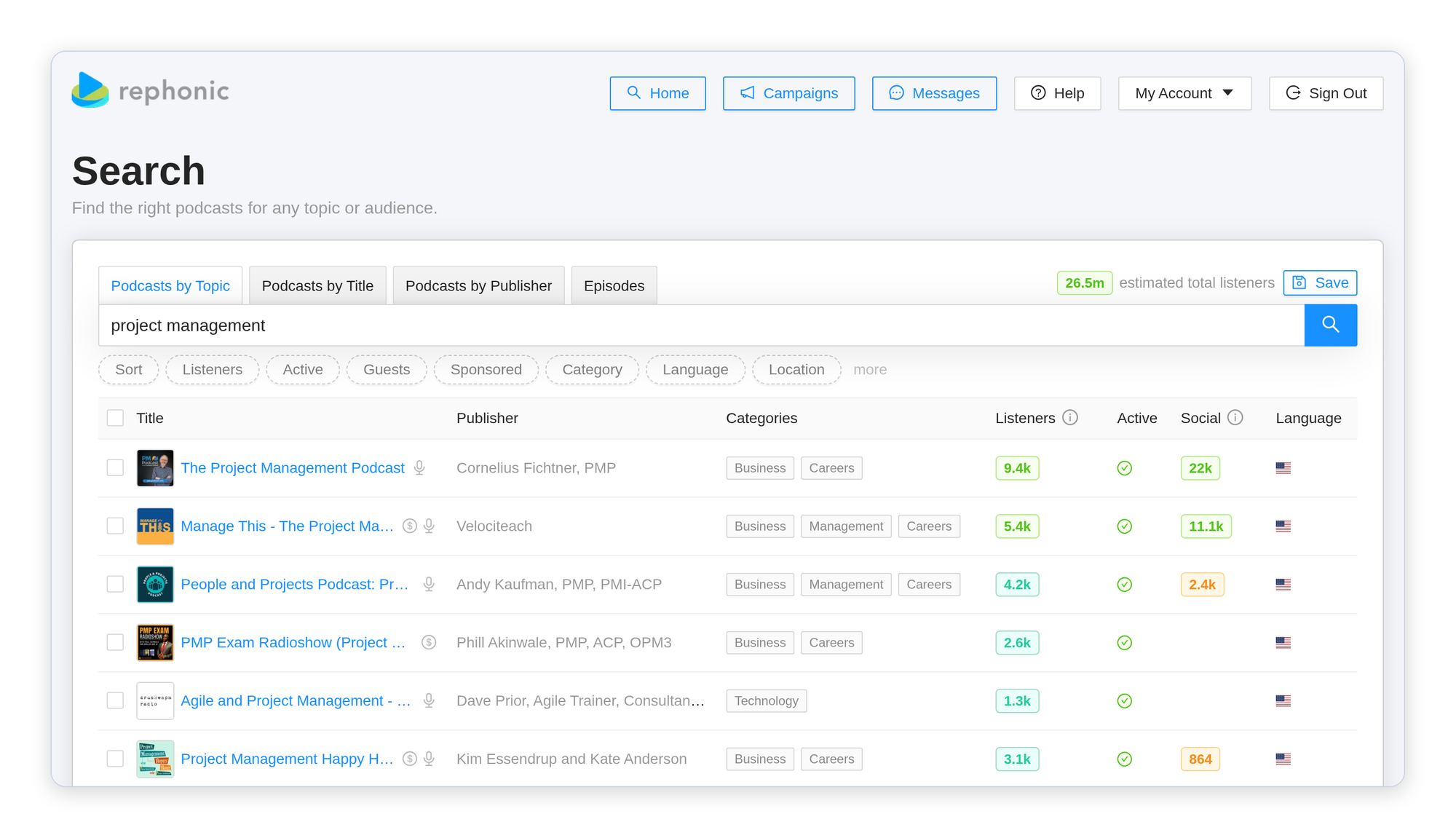
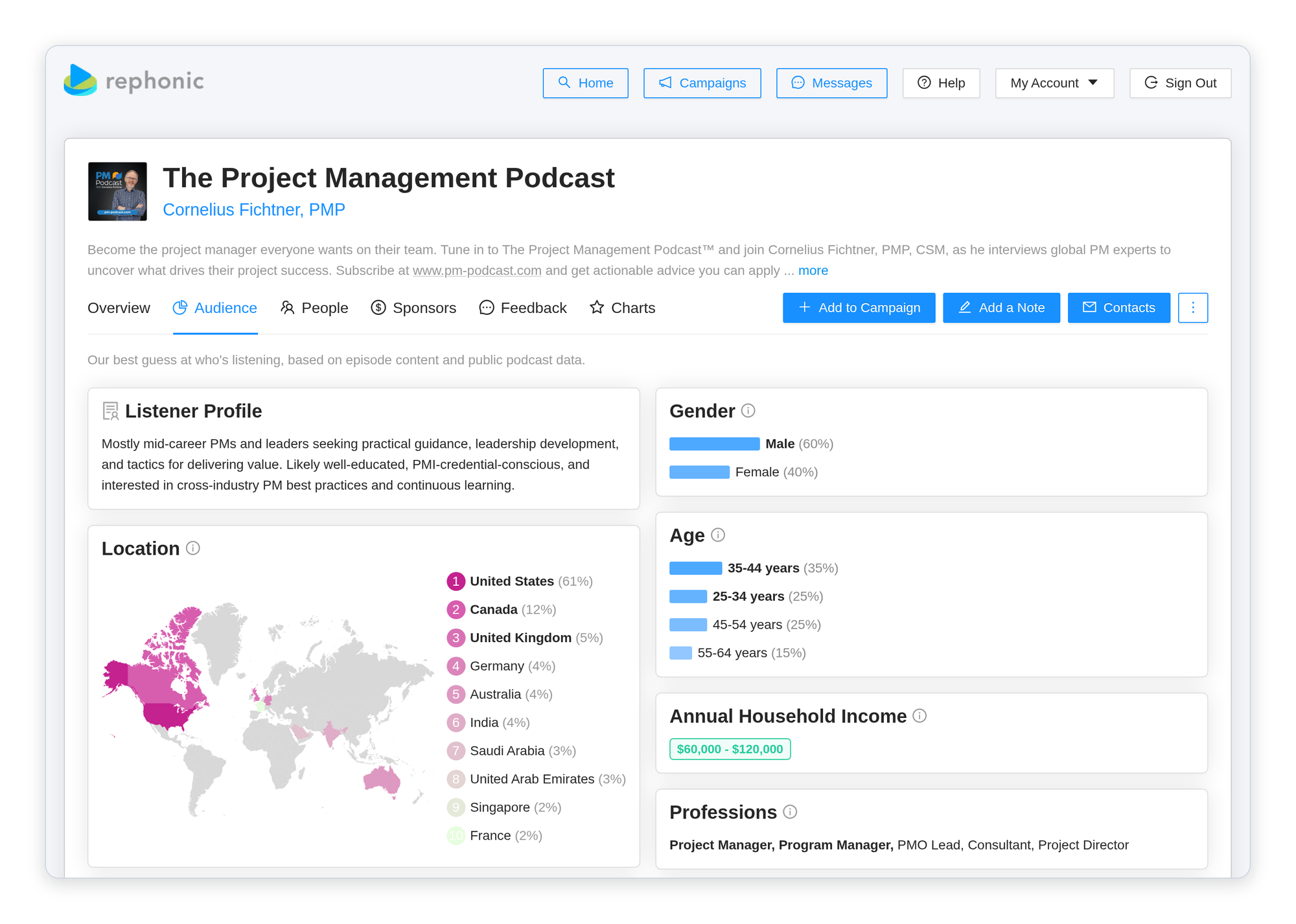
Then you qualify. Each show has an Audience page with a listener profile: likely location, age range, professions, household income and gender skew.
You check that a show's listeners match your client before you write a word of the pitch. Get that wrong and you burn everyone's time pitching shows that were never going to convert.
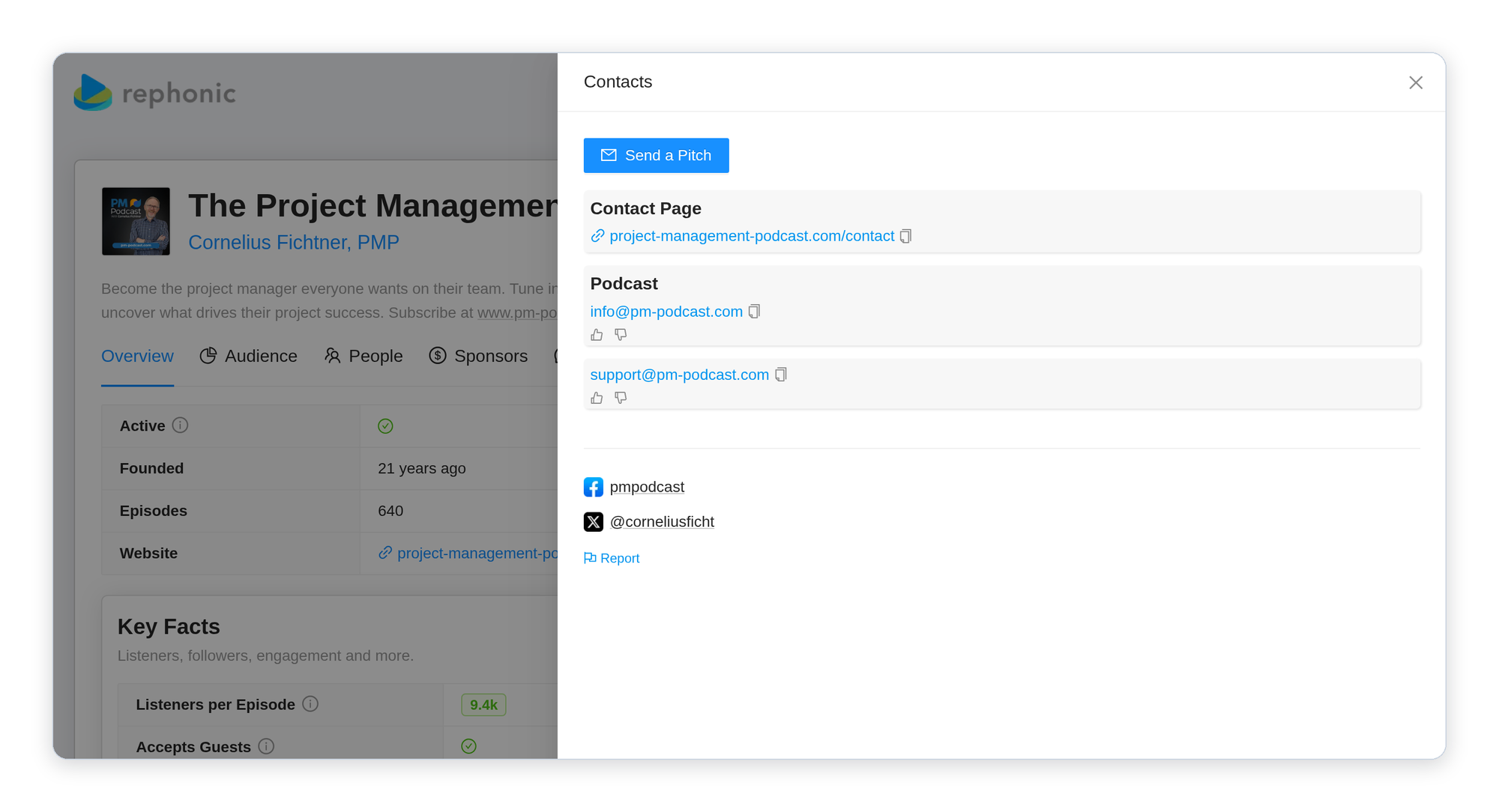
Contact details come next. Rephonic surfaces email addresses, contact pages and social accounts on each show's page, so you skip the scavenger hunt across websites and LinkedIn. In one of our own tests, tracking down guest contact info for six shows by hand took 40 minutes. On Rephonic it took under five.
Then you pitch and follow up from your own email address, without leaving the platform. Templates give you a starting point, automated follow-ups stop the moment a host replies, and every message is logged. On a team, those pitches and replies sit in a shared workspace instead of scattered inboxes, so two people never pitch the same host and nothing slips through.
Example campaign workflow with Rephonic
Here's how a campaign might actually run, using the project-management app from earlier.
You start by setting a target: say a dozen or so booked interviews on shows that remote-engineering and startup-ops listeners actually follow. Then you build a longlist, filtering Rephonic down to active, guest-friendly shows in that niche, checking the audience data on each, and saving maybe 120 candidates. From there you cut hard, dropping anything off-audience or low-fit and ranking the rest until you have the 50 or 60 worth a proper pitch.
Cold pitches from a brand nobody knows yet convert in the low-to-mid teens at best, so to land a dozen interviews you have to start from well over a hundred shows and expect most to say no.
From there you work through the shortlist, sending tailored pitches in small batches with a single follow-up each, all tracked in one place. As interviews land you record them, then clip and cross-post each one the week it airs. After a couple of months you look back at what actually converted, keep pitching the kinds of shows that worked, and drop the ones that didn't.
Podcast PR tips, tactics and advanced strategies
Once the basics are running, a few habits get you more bookings and more reach from the same work.
Time your outreach to what's going on in the business. A launch, a funding round, an award, or a story in the news gives a host a reason to book you now rather than someday, so lead with that hook while it's fresh.
It also pays to treat hosts as long-term contacts rather than one-off targets. They're influential in their niche and they talk to each other, so following up after an episode, sharing it and dropping a useful comment on their next post tends to turn one booking into a couple more through a referral.
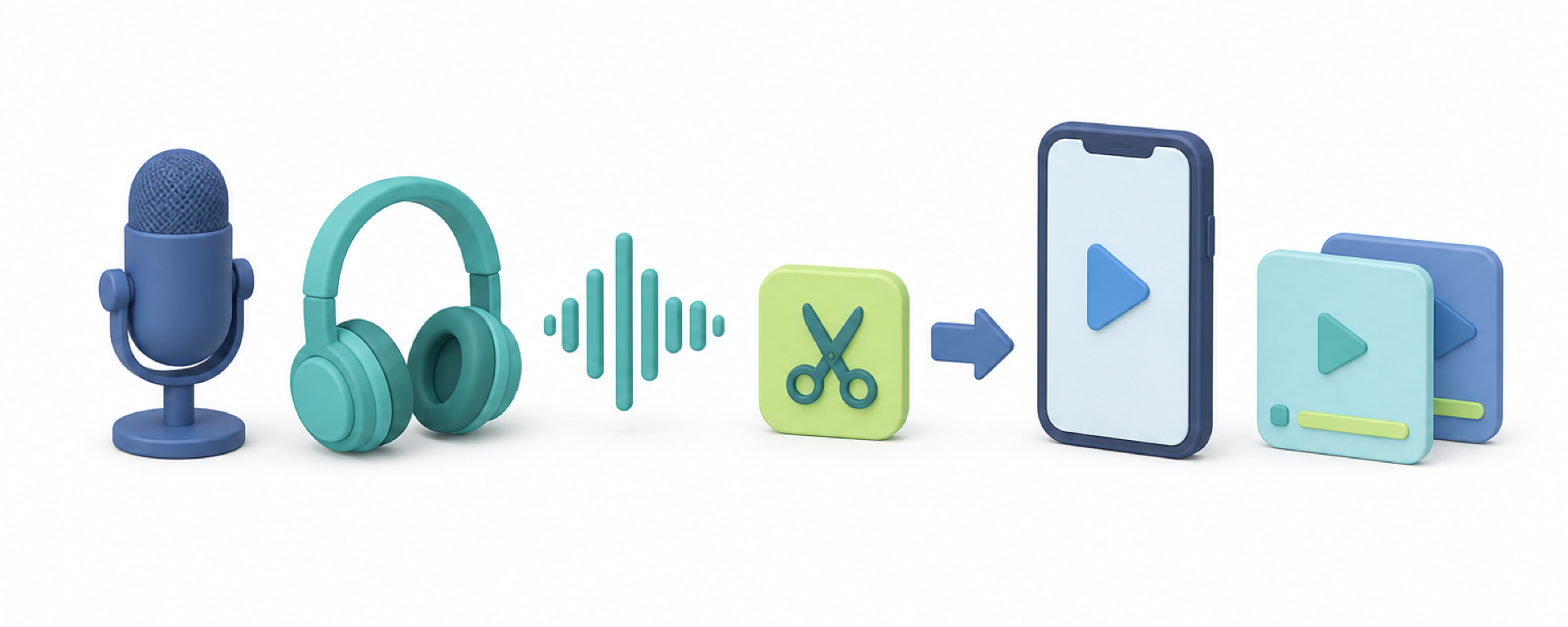
Then get more out of every episode once it airs. A 30 to 60-second vertical clip of your best moment does well on Instagram Reels, TikTok and YouTube Shorts and reaches people who would never sit through the full thing, so plan the clips and the cross-posting before you record. The other habit worth building is listening back to the audience. What listeners ask, and what hosts push back on, tells you how your positioning lands with real buyers, and it makes good raw material for your next pitch and your wider messaging.
One Rephonic-specific tip. Save a search for your niche so new shows come to you as they launch and old targets drop off your radar when they go quiet, which keeps your list current without a manual re-check every few weeks.
When (and when not) to hire a podcast PR agency
You can run all of this in-house, or you can pay a specialist agency to do it for you, and which one fits comes down to your situation.
Keeping it in-house works well when you have someone with a few hours a week to own outreach and a tool that handles the heavy lifting on discovery and tracking. It helps if your founder or your experts are comfortable on mic and will commit to prep. The payoff is that the host relationships, and everything you pick up along the way, stay inside the company. And when budget is tight, a tool costs a fraction of a retainer.
An agency is the better call when you need a lot of bookings fast and nobody in-house has the time to do it properly, or when it already has relationships with the shows you want and can open doors a cold pitch can't. If you'd rather have the whole thing off your plate and you have the budget for a monthly retainer, that's a fair trade too.
For most brands, though, the honest starting point is in-house. The work is learnable, and with a tool handling the repetitive parts you keep the host relationships and the know-how in the company. Bring in an agency once you hit a real ceiling on time, or when you're going after a few big shows where someone's existing relationship is what gets you through the door.
Final thoughts
Podcast PR is a slow build, and the brands that do well with it put the research first. They spend their hours finding the right shows and getting to know who listens, then let the pitching and the prep follow from there.
Stick with it for a few quarters and it starts to compound. A brand that keeps turning up on the shows its buyers actually listen to becomes a familiar name in the niche, the one that gets recommended when a buyer asks a peer, or asks an AI assistant, who they should be talking to. You don't get that from a burst of ads.
It only works if the show list is right. Pitch too wide, to shows whose listeners were never going to buy, and even strong interviews lead nowhere. Rephonic is the most complete podcast database for finding the right shows, checking who really listens, and running your whole outreach in one place. Ready to book more of the right podcasts?
Start your 7-day Rephonic trial and put your brand in front of the audiences that actually buy from you.
About the Author

James Potter started Rephonic in 2020 to answer a simple question: how many people actually listen to this podcast? The platform now estimates audiences for more than 3 million shows, and PR teams lean on those numbers to decide where a pitch is worth sending.